Tuesday, September 30, 2008

K is for knotting


Mrs. Nesbitt's ABC Wednesday Round 3 and ABC Wednesday Anthology (the no comment display) have
progressed to the letter K. My apologies this week for a sparse response to the K challange and little time to comment on other posts. I will try to make up for it in the future!


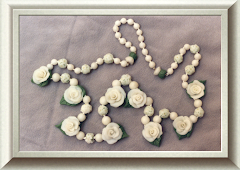
Macrame comprises a variety of Knots to create an object of practical or artistic merit. It was perfected by sailors on sailing ships. The first examples I saw were in the San Francisco Maritime Museum. I was a child at the time but determined that someday I would master the craft. During the macrame days of the 1960s I created hundreds of macrame objects, artistic or practical, and sold almost all of them to either individuals or galleries. This is the sole remaining piece of my own macrame that I now have. I made it as a wall hanging for my mother, and, when she died, I inherited it. This macrame hanging now bridges the width of a wall between my dining and breakfast areas, and serves as a complex knot between the two areas.

Saturday, September 27, 2008

No on California Prop 8

When I first saw the Sunday Scribblings’ prompt of weddings I was overwhelmed by the number of possibilities. My children and quite a few of the grandchildren have had beautiful and memorable weddings. Which ones should I write about? The perfect traditional church weddings? The simple one in Friends’ Meeting followed by a potluck dance and dinner in a rustic former church with a wood stove taking away the autumn chill and with half the guests playing their favorite instruments while the other half danced? Or should I choose the perfect one at a remote winery with a hillside view of autumn leafed vines and wooded hillsides falling away into the distance and an alter of natural branches twined with garden roses? Then how about the one on an excursion boat on the bay on a sunny day, like all the others imbued with happiness and hope? Or should I choose my own hastily assembled wedding, hasty because at the last minute I could not stand the thought of being parted from Otto for a year while he taught at Tufts College and I finished my degree at Stanford? (For those of you who don’t know, we celebrated our 67th wedding anniversary on September 3).

Yes, I remember each wedding with joy, which is why I have decided to write not about the weddings but about a ballot measure on which Californians will be voting in a few weeks time.

As of now, before the election, by decision of the California Supreme Court, marriage by couples of the same gender is legal. I greeted this Supreme Court decision with happiness for my many friends who could now experience the joy of legally proclaiming their love and intention to be joined in lifelong matrimony. Now there is a proposition on the November ballot (Prop. 8) which would reverse that court decision and make same sex marriages illegal in California.


None of the following photos were taken by me.
They are all from the web. I hope I have violated no copyrights.


Everything I have read in scientific literature concludes that sexual preference is determined by genetic factors. Same sex preference occurs not only in every culture but among animals as well. I don’t believe anyone should be denied the right to the fulfillment of the physical expression of love. I also believe that every couple should have the right to legally make permanent a commitment to one another. The California Supreme Court felt that it was a violation of civil rights of same sex couples to deny them that right.


One needs only to look at the joy on the faces of newlywed same sex couples to realize what longing they have had for the validation that marriage gives to their commitment.

In Mexico

I have neither gays nor lesbians in my extended family. I do have them as friends. I see no way in which marriage of anyone to anyone could threaten the marriages of heterosexual couples. Every wedding will be subject to the stresses of everyday life. Divorce might happen. Partners may stray. This is true regardless of the sexual orientation of a couple. Isn’t that the stuff of gossip magazines and soap operas?

First gay marriage in South Africa

Tuesday, September 23, 2008

J is for Jacaranda

The letter for Mrs. Nesbitt's ABC Wednesday Round 3
and ABC Wednesday Anthology is
J.


During the various years that I lived in Brazil, usually for months (but once for two years) I thought of the gloriously blooming Jacaranda trees that abounded there as being purely tropical. I haven't been back to Brazil for more than thirty years, and in that time, Jacaranda has appeared in Berkeley, California, one tree at a time. These two are in front yards a block south of my house.

Here the lacy branches of blue-blossomed Jacaranda permit the pale pinkish-purple Bougainvillea beyond them to be seen.

Friday, September 19, 2008

Invitation To a Ceremony


The Sunday Scribblings prompt is invitation.

“The Great Bear Invites You To the Winter Solstice”
On this, the longest night, they should sleep best,
but something summons bears from den-snug slumber.
Perhaps a wisp of carol disturbs their rest,
wafts from a village far below. Bears lumber
from earthy mouths of dens, and, stumbling, go
with stifled yawns and heavy-lidded eyes
to dent their paw-prints in the virgin snow.
Frost nips each nose; stars glitter in the skies.

This still clearing is hedged with sentinel pines
roofed by the shining sweep of Milky Way.
One by one they come, then wavering lines
of dusky shapes--the black, the brown, the gray,
the heavy gravid females, the born-last-spring
still close beside their mothers, grumpy males
crossly grumbling. They form a ragged ring.
The murmurs fade; expectant hush prevails.

The eldest clears her throat, proclaims this hour,
then points to stars that trace the sacred sight--
The Great Bear—One who holds the only power
to turn the sun back from its dreaded flight.
The young ones gaze with wonder and the old
with troubled reverence. In the ancient way
they solemnly rise upright, move to hold
their neighbors, paw-to-shoulder, start to sway.

It's not the same light revelry that spurred
their summer polkas. This is ritual turning
and clapping paws to inward rhythms heard
in ursine souls, mute music of their yearning.
Bit by bit the dance grows swift. There springs
an ecstasy of motion gripping all.
They spiral, swirl and twirl in dizzy rings
until, exhausted, panting, spent, they fall.

An old bear, flecks of grey in once-dark fur,
with faltering steps approaches each prone bear.
He dips his stick into the gourd to stir
the sacred honey, touches it to where
each open mouth awaits. They're reassured
that sunlight will return and days grow long
and bushes lush with berries be their reward
and salmon leap, bees buzz their honeyed song.

Already languorous, bears rise to their feet,
give one another ritual hugs, then go,
eyes almost closed again, back to the sweet
warm snugness of each den, secure from snow,
to curl in their soft fur, nor need to rouse
to plunge for leaping salmon that have chanced
into their dreams. They wonder as they drowse
if they have danced or only dreamed they danced.

My poem and drawing were actually done several years ago, but seemed appropriate to the "invitation" prompt, even though we are just approaching the autumn equinox.

Monday, September 15, 2008

I is for Intrusion


Mrs. Nesbitt's ABC Wednesday Round 3 and ABC Wednesday Anthology have progressed to the letter "I".


This big buck intruded into our back yard yesterday morning. We are familiar with does and fawns, who apparently consider our back yard a safe haven in which to shelter and forage for a night or a day. One doe even chose our yard in which to give birth to her twin fawns. This buck was a surprise.

He settled among the lilies, completely without fear. He looked at me in my open upstairs window apparently deciding that that was a camera not a deer rifle in my hands and thereafter posed shamelessly.

"What are you looking at?" He kept looking at me a bit challengingly but continued toward the house, finally coming so close that I looked almost directly down on him.

Above: he nibbles on the remainder of the wild roses near the door to our basement. After that he fell asleep by the door.

Thank You Laini!


I feel very honored to receive this award from Laini Taylor at Grow Wings! There is no one in the blogsphere for whom I have more respect and admiration. I have even contemplated pink hair dye on my white mop of hair. For her many accomplishments, go to her website and check out her art (fabulous, funny, or beautiful creatures) and her writing, and - well, everything else!

Thanks again, Laini!

Thursday, September 11, 2008

I Once Owned a Coffee Farm

The Sunday Scribblings prompt is "coffee."

Candace and Clinton with baby Byron and coffee trees.
Be sure to click on photo to get full effect of blue skies and red coffee berries


We once owned a farm in Paraguay.

In 1954 we took advantage of Otto’s sabbatical year from U.C. Berkeley to move our young family to Sao Jose dos Campos, Brazil, where Otto then taught at the new Instituto Tecnologico de Aeronautica. Clarence Johnson, who had been a fellow passenger on the Delta liner on which we had sailed to Brazil, invited us to visit the area in Paraguay where he, with other Americans and Brazilians, was developing a frontier area into 100 contiguous, individually owned coffee farms, all to be administered by Johnson’s company. We accepted the invitation and stayed in their modest residence. It was constructed of wood from the site, sawn in the primitive sawmill that was part of the infrastructure of this new colony.

At night, through the screens, we heard the cacophony of jungle whistles, squawks and hoots. Under the deep blue sky of day, Clarence took us to the upper edge of Farm 43, the one that later became ours. It was already planted with tiny seedlings which were protected from the intense sunshine by slats over the holes in which they grew. For every forty hectares of land cleared for planting, the policy was to leave ten additional hectares of native jungle. Tall trees and dense undergrowth studded the gently undulating hills.

We hiked down through the rows that would eventually be rows of glossy-leafed coffee trees to meet the colonists who had developed the farm thus far. With wide smiles of welcome and low bows, the Japanese family welcomed us to their simple house, outside of which a fire burned beneath a steel oil-drum heating water for their baths. The Japanese government, in the wake of World War II, had become worried about overpopulation and had paid the passage of families who wished to emigrate. This family was among them, attracted by the fair wages offered and the promised bonus of the fourth year coffee crop, the time at which the trees were expected to mature.

(I will jump ahead of my story. The fourth year harvest was a bumper crop of grade A coffee beans which brought each family of colonists many thousands of dollars. Most of the Japanese families, including ours, left their temporary jobs to buy land of their own or to start businesses.)

Clarence took us on to view other parts of the infrastructure his company had installed, the nursery of coffee seedlings, the sawmill, and the drying sheds and the new school for the children of the colonists. We did not decide to buy a farm on this first visit, but we did give it careful thought, found it compatible with our ideas of community development, and bought our farm a few weeks later.

In the following years we visited the farms from time to time, and have slides of our children at various ages posing among the coffee plants. One Christmas, after Otto had given a talk in Brazil, we even spent Christmas at the farms, staying with the Johnsons and celebrating Christmas with expatriate Americans who had built homes on their coffee farms.

We eventually made modest profits from the sale of our superior varieties of coffee to coffee-conscious countries like Germany, where, even at higher prices, our coffee was preferred over that from Africa.

Have you gathered from my past posts that, having grown up entranced by my father’s tales of South America, that I wanted to be part of it? I apparently infected my children with the same fever, especially Candace who was ten years old on our first Brazilian sabbatical. She passed it on to her husband, Clinton. They had already spent many years in Brazil when, in 1974, they moved from the state of Sao Paulo in Brazil to Paraguay, where Clinton became the new manager of the coffee farms. The farms were now several times more in number than the original 100.

They prospered under Clinton’s management . Then the great friagem of 1975 blasted Antarctica cold to the north, sweeping all the way to the tropics and devastating the coffee plantations of Brazil and Paraguay, leaving bleak landscapes of dead coffee trees. That friagem even killed many huge old jungle trees.

I don’t remember exactly when we sold our farm, now planted to other crops. I know that it was after we had built two new houses, each with a central breezeway to keep the Paraguayan farm families comfortable in hot weather. I know that the Paraguayans who bought farm 43 were delighted that we didn’t ask more for it. And we felt that it was appropriate (although I admit to some sadness) that the farm was back in the hands of its countrymen.

Move over, Isak Dinesen! You had a farm in Africa. I had a farm in Paraguay!

I still enjoy a good cup of coffee. May I recommend Peet’s?